El arte como inutilidad sublime
Los renglones torcidos de DiosEl arte como inutilidad sublime turns the usual suspicion of uselessness into a measure of artistic value. In a conversation about the arts, the speaker argues that art begins where people add something unnecessary to the bare requirements of survival: the greater that excess, the more sublime the art. Poetry becomes the argument’s limit case, prized not despite its lack of biological function but because of it.
Definition and Reversal
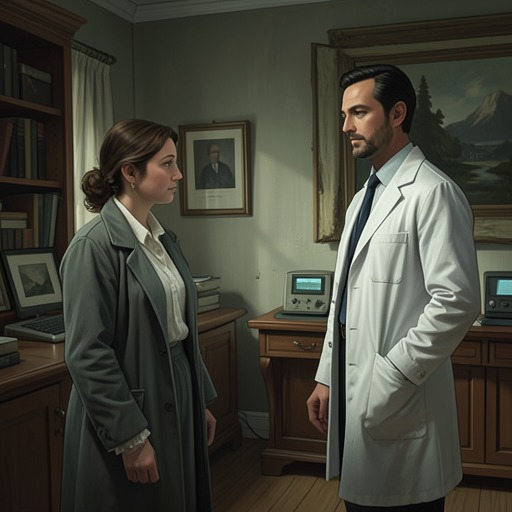
The idea takes shape in response to a doctor asking what the speaker thinks of the arts. When he tests whether she regards them as trivial pastimes for people with nothing better to do, she rejects that premise. Art is not diminished by being useless; it is more sublime in proportion to its uselessness. The exchange thus reverses a familiar hierarchy in which practical benefit establishes worth and the impractical is treated as frivolous.
The reversal depends on distinguishing biological necessity from human value. The speaker describes humans as the only animals that create needs unrelated to the individual’s subsistence or the species’ reproduction. Such needs are not presented as mistakes or distractions. They mark a capacity to go beyond what life strictly requires, and artistic activity belongs to that surplus. Uselessness, in this account, names a release from the demands of survival rather than an absence of meaning.
The Arts Beyond Necessity
The speaker makes the distinction concrete through ordinary acts of embellishment. Eating is necessary for nourishment, but seasoning adds pleasure to the satisfaction of hunger. Clothing is necessary for warmth, yet the speaker’s examples extend beyond that basic function to the adornment associated with fashion. Shelter answers a primary need, while decoration adds something beyond protection. Gastronomy, haute couture, and decoration are accordingly described as early arts: forms made from excess added to eating, clothing, and shelter.
These examples give the concept a broad reach. Art is not confined to acknowledged masterpieces or specialized cultural institutions; it appears wherever people transform a necessary function through an unnecessary addition. The examples move from food to clothing to the arrangement of inhabited space, showing the same pattern across different material needs. What matters is not that practical functions disappear, but that they cease to be the whole purpose of an activity. Pleasure, adornment, and decoration accompany necessity without being reducible to it.
That reasoning also explains why uselessness is not synonymous with triviality. The speaker’s examples begin with everyday practices, but their very ordinariness makes the principle legible: human life repeatedly exceeds its minimum conditions. The value she assigns to art rests on that capacity for excess. Its distinction lies in what it adds, not in a measurable contribution to nourishment, warmth, or shelter.
Poetry as the Limit Case
When the doctor asks how she judges poetry, the speaker places it alongside painting in merit, but considers poetry still more useless. She tests that claim by considering an image of the heart as a snake shedding its skin, held in the speaker’s fingers and marked with wounds and honey. Her analysis points out the image’s bodily impossibilities: a heart does not shed skin like a serpent, and neither a heart nor a snake is literally coated with honey. The image does not function as a practical description of anatomy. Its force lies elsewhere, in an imaginative combination that ordinary biological facts cannot make useful.
Poetry consequently occupies the furthest point from biological service among the arts discussed. The speaker calls it the most useless in biological terms and, for that very reason, the greatest. Her ranking links radical impracticality with intellectual and spiritual distinction. Poetry is not simply a more elaborate tool; it exceeds the measure by which tools and actions are judged according to immediate need.
Human Meaning and the Argument’s Form
The exchange develops its claim by moving from a direct question about art to a definition of human distinctiveness, then to everyday examples and finally to poetry. That progression makes the claim cumulative: first, the standard of usefulness is challenged; next, its limits are demonstrated in familiar activities; at last, poetry is held up as the most extreme test. The speaker’s answer is argumentative rather than a bare declaration, using the contrast between biological function and human invention to explain why the arts matter.
The closing comparison makes the idea explicitly humanist. Poetry is described as the least irrational, the most intellectual and spiritual, and the most human insofar as being human means rising above inferior forms of life. This does not mean that every useless act is automatically art, or that the conversation supplies a formal test for artistic merit. Its narrower claim is that artistic value cannot be judged solely by survival, reproduction, or practical service. El arte como inutilidad sublime gives creative excess a positive meaning: what contributes least to biological necessity may disclose most clearly the human capacity to imagine beyond it.